Packing for a trip should feel exciting, not stressful. However, choosing the wrong bag can turn a smooth journey into a frustrating ordeal at the gate. Airlines have specific rules about what you can bring on board, and your tote bag needs to fit within those limits. Getting this right before you travel saves you time, money, and a lot of headaches.
This guide will help you choose a tote bag that works perfectly for air travel. You will learn what size limits to follow, what features to look for, and how to pack smartly so your bag always makes it on the plane with you.
Why Your Bag Choice Matters More Than You Think
Many travelers assume any bag will do. That assumption leads to problems. Gate agents measure bags. Overhead bins fill up fast. And if your tote is even slightly too large, you could be forced to check it and pay an unexpected fee.
Additionally, not all tote bags are built for travel. Some look great but have no structure, no organization, and no way to keep your belongings secure during a flight. Therefore, choosing the right bag from the start sets you up for a much smoother experience.
Understanding Airline Size Rules
Before you shop, you need to understand the sizing landscape. Airlines around the world have different rules, and they change more often than most travelers realize.
In the United States, most major carriers allow a personal item in addition to a carry-on. A tote bag almost always falls into the personal item category. Typical personal item dimensions hover around 18 x 14 x 8 inches, though this varies by airline. Some budget carriers are stricter and enforce limits of 16 x 12 x 6 inches.
European low-cost airlines like Ryanair and EasyJet are among the strictest in the world. They measure bags at check-in gates and charge fees on the spot for oversized items. Therefore, if you fly budget airlines regularly, you need a bag that fits on the smaller end of the spectrum.
Always check the specific airline’s website before your trip. Do not rely on general estimates. Rules change, and the responsibility falls on you as the traveler to know them.
The Difference Between a Personal Item and a Carry-On
This is a point that confuses many travelers. A carry-on goes in the overhead bin. A personal item goes under the seat in front of you. Most airlines allow one of each.
Cabin luggage that qualifies as a carry-on tends to be larger, often up to 22 x 14 x 9 inches. A tote bag, on the other hand, is usually treated as a personal item. This is actually an advantage. You can bring both a carry-on suitcase and a tote bag on most flights, giving you extra packing space without paying for checked luggage.
However, if your tote is too large, the airline may reclassify it as a carry-on. That means you could lose your right to bring a separate overhead bag. Understanding this distinction helps you pack strategically.
Key Dimensions to Look for When Shopping
When you shop for a travel tote, size is the first thing to check. Look for bags in the range of 17 x 13 x 7 inches. This size comfortably meets most airline personal item requirements while still giving you enough space to carry essentials.
Avoid bags that are significantly wider than they are tall. Wide bags take up more floor space under the seat and may not fit properly. A bag with a structured bottom also collapses less easily, which can make it harder to slide under a seat when it is fully packed.
Additionally, choose a bag that compresses slightly when needed. Soft-sided totes made from nylon or canvas can be squeezed into tight spaces. That flexibility can save you at a strict gate.
Features That Make a Tote Bag Travel-Ready
Organization Matters
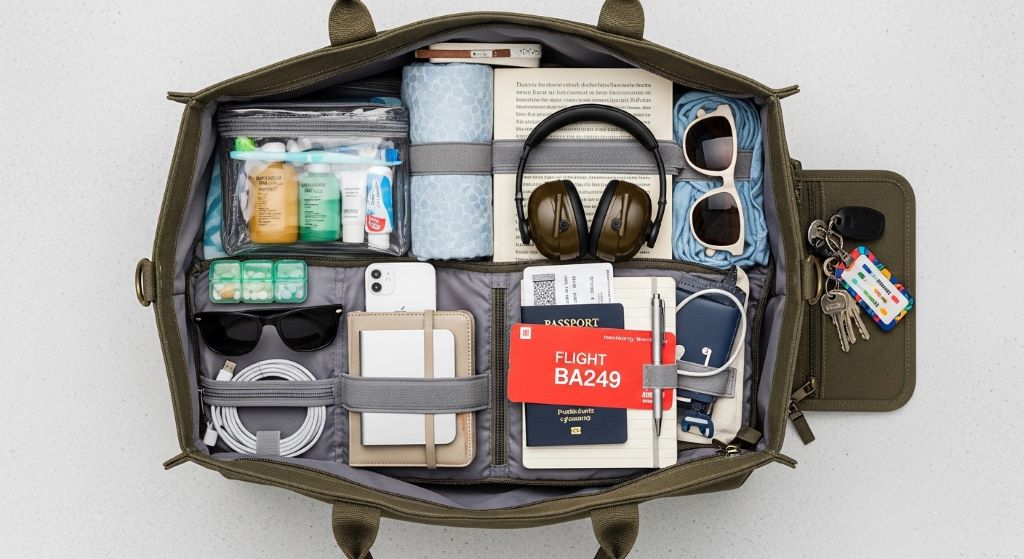
A good travel tote has multiple compartments. You want a pocket for your passport and boarding pass, a secure zip pocket for valuables, and easy access to your phone and keys. Open-topped totes look stylish, but they are not ideal for airports. Things fall out. Additionally, they offer no security for your belongings.
Look for a tote with at least one zippered main compartment. This keeps your items safe during overhead storage and busy terminal walks.
Comfortable Straps
Airports involve a lot of walking. Thin, rigid straps become painful quickly. Look for wide, padded shoulder straps. Some travel totes also include a luggage sleeve — a flat panel on the back that slides over the handle of a rolling suitcase. This feature is extremely useful if you are also bringing a roller bag.
Durable Materials
Travel puts bags through a lot. Your tote will be stuffed under seats, pulled through security, and tossed into overhead bins. Therefore, choose materials built to last. Ballistic nylon and high-denier polyester are two of the most durable options. They resist tearing, repel light rain, and are easy to wipe clean.
Avoid totes made from thin cotton canvas for air travel. Cotton absorbs moisture, tears under stress, and generally wears out much faster.
Weight of the Bag Itself
Every ounce counts when you are traveling. A heavy bag cuts into your luggage allowance before you even start packing. Look for lightweight totes that still offer structure and durability. Many modern travel totes weigh less than one pound empty, leaving more room for your actual belongings.
Airline Approved Bags: What to Look For on the Label
Some brands specifically market their bags as airline approved bags. While no universal certification exists, these labels typically mean the manufacturer has designed the bag to fit common airline personal item dimensions.
However, do not take this claim at face value. Always measure the bag yourself and compare it to your specific airline’s rules. A bag labeled as compliant for one carrier may still exceed the limits of another. Therefore, rely on measurements, not marketing language.
How to Pack Your Tote for Maximum Efficiency
Choosing the right bag is only half the battle. How you pack it also determines whether it fits comfortably under the seat.
Start with the heaviest items at the bottom. This keeps the bag stable and prevents it from tipping over in the aisle or gate area. Place your laptop or tablet in a padded sleeve if your bag has one, ideally near the back panel for easy security screening.
Keep essentials at the top or in front pockets. Your boarding pass, headphones, lip balm, and snacks should all be within easy reach. You do not want to dig through a packed bag while seated in a tight cabin seat.
Additionally, avoid overstuffing. A tote that is crammed full will not compress at all. That rigidity makes it harder to fit under the seat, especially on smaller regional aircraft where the space is limited.
Best Styles of Tote Bags for Air Travel
Not every tote design is equally suited for flying. Here are styles that tend to work well in airport and cabin environments:
- Structured totes with a flat bottom and zip closure offer the best combination of organization and security.
- Collapsible packable totes work great as a secondary bag that can fold flat when not in use.
- Convertible totes that shift between shoulder bag and backpack offer flexibility in busy airports.
- Slim vertical totes fit neatly under airplane seats without taking up too much legroom.
Each style has trade-offs. However, all of the above can qualify as cabin luggage if sized correctly and packed with care.
Budget vs. Premium: Does Price Affect Compliance?
The short answer is no. A bag’s price does not determine whether it meets airline rules. What matters is size, not cost. You can find perfectly compliant totes for under thirty dollars. Conversely, some expensive designer totes are too large to qualify as personal items.
That said, higher-priced bags often use better materials and offer more thoughtful organization. If you travel frequently, investing in a well-made tote bag can pay off over time. It will hold up through dozens of trips where a cheaper version might fray or break.
Conclusion
Selecting a carry-on tote bag that meets airline rules does not have to be complicated. Start by knowing your airline’s specific personal item size limits. Then look for a bag in the 17 x 13 x 7 inch range with durable materials, smart organization, and comfortable straps.
Remember that airline approved bags and proper cabin luggage compliance come down to measurements, not marketing. Always verify the dimensions yourself before you fly. Pack efficiently, avoid overstuffing, and choose a design that fits your travel style.
With the right tote in hand, you will breeze through airports, skip baggage claim, and arrive at your destination ready to enjoy every moment of your trip.
Frequently Asked Questions
What is the standard size for a personal item tote bag on most airlines?
Most major airlines in the United States allow personal items up to around 18 x 14 x 8 inches. Budget carriers, especially in Europe, often have stricter limits closer to 16 x 12 x 6 inches. Always verify with your specific airline before traveling.
Can I bring both a carry-on suitcase and a tote bag on a flight?
Yes, on most airlines you are allowed one carry-on bag for the overhead bin and one personal item, such as a tote, for under the seat. Both must meet the airline’s size requirements for their respective categories.
Will airline staff actually measure my tote bag at the gate?
It depends on the airline and how busy the flight is. Budget carriers like Ryanair are known for strict enforcement and may use physical sizers at the gate. Full-service carriers tend to be less strict but can still ask you to check a bag if it looks oversized.
What materials are best for a travel tote bag?
Ballistic nylon and high-denier polyester are the best choices. They are lightweight, durable, and water-resistant. Avoid thin cotton canvas for frequent travel as it wears out faster and absorbs moisture.
Does a tote bag count as a carry-on or a personal item?
A tote bag is almost always classified as a personal item, which goes under the seat in front of you. Only if the tote is unusually large might an airline reclassify it as a carry-on. Keeping your tote within standard personal item dimensions avoids this issue entirely.
Related Topics:
What to Do on a Road Trip: Boredom-Busting Ideas for Your Next Adventure
Benefits of Choosing a Boating Holiday
About Author
