Hawaii is the only place on Earth where a surfer can ride a 9’6″ longboard on a gentle Waikiki roller at sunrise and watch someone drop into a 10-foot Pipeline barrel on a 6’2″ shortboard that same afternoon—both experiences defining what “surfing in Hawaii” means equally. Choosing between longboard surfboards and shortboards for Hawaii depends on which wave experiences you prioritize, your physical ability, and how you define fun in the water.
A longboard is a surfboard exceeding 8 feet (typically 9’0″–10’0″) with generous volume, flat rocker, and a rounded nose designed for smooth gliding and traditional nose-riding style. A shortboard is a performance-oriented board under 7 feet (typically 5’6″–6’6″) with reduced volume, increased rocker, and refined rails designed for radical maneuvers in steep, powerful waves. The shortboard vs. longboard debate in Hawaii carries more complexity than anywhere else—because Hawaii offers the full spectrum of wave types where each board genuinely excels. This isn’t a matter of one being “better”—it’s about understanding where each becomes the superior tool for the conditions at hand.
How Do Longboards and Shortboards Differ in Performance?
Longboards maximize wave count, glide, and ride time through volume and length—while shortboards maximize maneuverability, vertical surfing, and performance in steep, powerful waves through reduced dimensions and refined design features.
Performance comparison across key metrics:
| Performance Factor | Longboard | Shortboard | Winner in the Hawaii Context |
|---|---|---|---|
| Wave catching (paddle speed) | Excellent—catches waves early | Limited—requires precise positioning | Longboard (especially in small surf) |
| Turning ability | Wide, sweeping turns only | Rapid, vertical, precise turns | Shortboard (in powerful waves) |
| Speed generation | Inherent glide, less pumping needed | Requires active pumping, generates speed through turns | Depends on the wave (longboard in slow waves, shortboard in steep waves) |
| Tube riding | Extremely difficult (size prevents fitting in tube) | Designed for tube riding | Shortboard (no contest) |
| Nose riding/cross-stepping | Primary maneuver repertoire | Impossible | Longboard (unique art form) |
| Big wave safety | Dangerous above 6 feet (hard to duck dive, heavy in wipeouts) | Manageable with experience | Shortboard/guns for bigger surf |
| Ride length/time | Longer rides (maintains speed in flat sections) | Shorter, more intense rides | Longboard (especially at point breaks) |
| Crowd navigation | Harder—long boards are dangerous in crowded water | Easier—compact and maneuverable | Shortboard in crowded spots |
Where Do Longboards Excel in Hawaii?
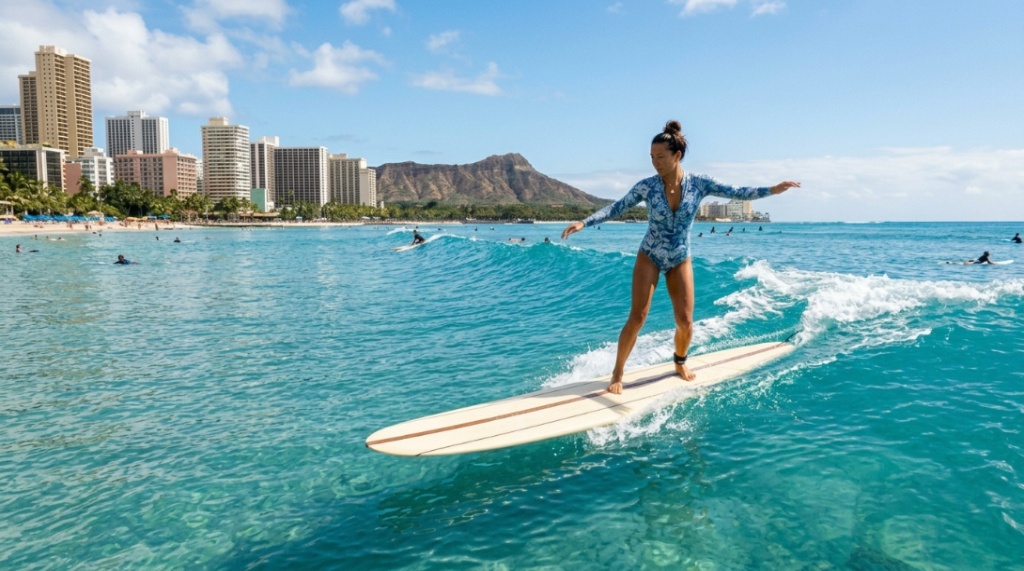
Longboards excel on Hawaii’s gentle, rolling waves—particularly Waikiki, Queens, Canoes, and summer south shore breaks—where their superior glide produces the longest rides and highest wave counts in conditions too small or soft for shortboard performance.
Prime longboard locations and conditions in Hawaii:
- Waikiki (Canoes, Queens, Populars): The spiritual home of Hawaiian longboarding. Gentle, long-breaking waves are perfectly suited to nose-riding, cross-stepping, and classic longboard style. Rides can last 100+ yards on good days. Shortboards are possible but underperform—too slow and short for the wave shape.
- Ala Moana Bowls (small days): When 2–3 feet, this playful wave rewards longboard glide. On bigger days, it becomes a shortboard wave—but small-day longboarding here is pure Hawaiian fun.
- Summer south shore (1–4 feet): June through September, Hawaii’s south shore receives consistent small-to-medium swells. Longboards thrive in this window—shortboards often lack the wave energy needed to generate speed.
- North Shore gentle days (rare): Occasional 2–3-foot clean days on the North Shore create longboard opportunities at Laniakea and Chun’s Reef. Magic sessions that North Shore shortboarders miss because they don’t own longboards.
Longboard advantages unique to Hawaii:
- Waikiki waves break over the reef for 200+ yards gently—only longboards can maintain speed through these entire rides
- Hawaii’s trade winds create small, choppy days where longboard volume planes over surface texture that bogs shortboards
- Tourist spots (Waikiki) are often too gentle for shortboards—longboards let you have fun anywhere
- Hawaiian surf culture deeply respects classic longboarding—it’s celebrated, not seen as “less than” shortboarding
Where Do Shortboards Excel in Hawaii?
Shortboards excel on Hawaii’s powerful, hollow reef breaks—Pipeline, Backdoor, Sunset Beach, and medium-to-large North Shore waves—where reduced dimensions allow the rapid maneuvers, tube riding, and control needed to navigate steep, fast, powerful wave faces safely.
Prime shortboard locations and conditions:
- Pipeline/Backdoor: The world’s most famous wave. Hollow, powerful, fast, and shallow. Only shortboards (and specialized Pipeline shapes) allow the precise positioning needed to navigate these tubes. Longboards are genuinely dangerous here.
- Sunset Beach: Powerful, shifting peaks on deep reef. Shortboards and step-ups provide the control needed to handle Sunset’s variable takeoff zones and powerful faces. Board speed from wave power eliminates the need for longboard paddle speed.
- Haleiwa: Hollow, fast right-hand point break. Shortboards allow the bottom turns and pocket riding that Haleiwa’s steep walls demand.
- North Shore (4+ feet): Once waves exceed chest-to-head height on the North Shore, shortboard maneuverability becomes a safety tool—you need to be able to turn sharply to avoid closeout sections and navigate powerful breaking zones.
- Diamond Head (solid days): Fast, hollow right when solid south swells hit. Shortboard territory for the turns and tube opportunities this wave presents.
Shortboard advantages in Hawaii’s powerful surf:
- Duck diving through Hawaiian sets requires low-volume boards that can be pushed underwater
- Tube riding—Hawaii’s defining surfing experience—requires compact boards that fit inside hollow waves
- Vertical surfing on steep faces requires an instant turning response that longboard length prevents
- Wipeout safety improves with shorter boards—less mass means less impact force in heavy waves
Which Board Is Better for Your Fitness and Body Type?
Longboards favor surfers who prioritize grace over athletics and want enjoyable sessions regardless of fitness level—while shortboards demand high paddle fitness, core strength, and explosive agility that favors younger, athletically active surfers.
Body type and fitness considerations:
- Larger/heavier surfers (200+ lbs): Longboards provide natural flotation that larger bodies need for efficient paddling. Shortboard volume (25–35 liters) is often insufficient for heavier surfers to paddle effectively—r, requiring significant fitness to compensate for reduced buoyancy.
- Older surfers (40+): Longboards maintain accessibility as paddle fitness naturally decreases with age. The gentle pace and wave-catching efficiency of longboarding allow surfers to remain active in the water decades longer than shortboarding demands. Many Hawaii surfers transition toward longboarding as they mature.
- Lightweight athletic surfers (under 160 lbs): Shortboards become viable at lower fitness thresholds because lighter bodies need less volume for adequate flotation. The agility demands of shortboarding favor leaner, quicker body types.
- High-fitness surfers (any size): Strong paddlers can ride shortboards regardless of body type because fitness compensates for volume deficiency. However, even incredibly fit surfers enjoy longboarding—fitness doesn’t diminish the appeal of glide and style.
The honest physical truth: shortboarding in Hawaiian waves is genuinely exhausting. North Shore paddle-outs, fighting currents, and duck diving heavy walls require swim-athlete conditioning. Longboarding in Hawaiian waves is moderately demanding but accessible to anyone with basic fitness. Neither is right nor wrong—but honest fitness assessment prevents frustrating sessions where exhaustion ends your day before fun begins.
Can You Own Both? The Two-Board Hawaii Strategy
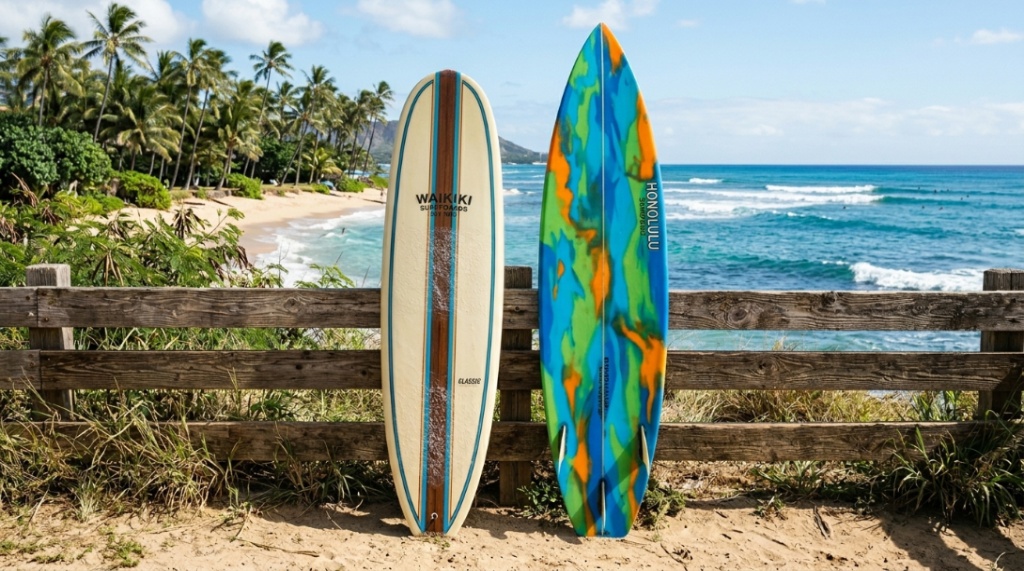
The smartest approach for most Hawaii surfers is owning both a longboard and a shortboard—using each for the conditions where it excels rather than forcing one board to cover Hawaii’s impossibly varied wave spectrum.
Two-board strategy:
- Longboard (9’0″–9’6″): Your 1–4 foot board. Waikiki sessions, small south shore days, mellow morning surfs, fun with friends regardless of conditions. This board ensures you never have a “too small to surf” day in Hawaii. It’s also your high-wave-count, pure-joy board.
- Shortboard (5’10″–6’6″): Your 4+ foot board. North Shore sessions, solid south swells, any wave with power and consequence where control and maneuverability matter. This board enables performance surfing when conditions provide the energy.
For intermediate surfers not yet ready for a shortboard, replace the shortboard with a funboard (7’0″–7’6″)—the same two-board logic but with the shorter board being manageable for intermediate abilities while still providing more maneuverability than the longboard.
The two-board approach means you surf every day conditions allow—never stuck watching waves because you only own equipment for one end of the spectrum. In Hawaii, where waves range from ankle-high Waikiki to triple-overhead Pipe within a 30-minute drive, this versatility is invaluable.
What Does Hawaiian Surf Culture Say About the Debate?
Hawaiian surf culture views longboarding and shortboarding as equally valid expressions of wave riding—with deep respect for both disciplines, particularly since Hawaii birthed both the ancient art of longboarding and the modern revolution of shortboard performance.
Cultural context:
- Historical roots: Ancient Hawaiians surfed on 12–16-foot solid wood boards (papa he’e nalu). Longboarding connects directly to surfing’s Hawaiian spiritual origins. There’s no “lesser” status in the culture that invented the activity.
- North Shore respect: Pipeline shortboarders and Waikiki longboarders are equally respected in Hawaii’s surf community. The measure isn’t what you ride—it’s how you ride it and how you treat the ocean and other surfers.
- Modern integration: Many top Hawaiian surfers ride both. John John Florence longboards for fun. Waikiki legends occasionally shortboard. The rigid separation between longboard and shortboard identity exists more on the mainland than in Hawaii.
- Lineup etiquette: Hawaii enforces strict lineup priority regardless of board type. Longboarders who use their paddle advantage to take every wave earn friction. Shortboarders who drop in on longboarders earn friction. Respect is universal—board type is irrelevant.
The only genuine stigma in Hawaiian surf culture: being on the wrong equipment for conditions in a way that endangers others. A longboard in heavy Pipeline is dangerous (can’t control it, becomes a missile). A shortboard at packed Waikiki, falling repeatedly into others, is dangerous. Match equipment to conditions, surf with awareness, and both boards earn equal respect.
Conclusion
Neither longboards nor shortboards are “better for Hawaii” universally, y—because Hawaii contains every wave type on Earth within a small island chain. Longboards are better for Waikiki’s gentle rollers, small south shore days, and the pure joy of glide and style surfing. Shortboards are better for Pipeline’s hollow tubes, North Shore power, and any wave where maneuverability becomes a safety necessity. The best answer for most surfers? Own both. Use each where it excels.
If forced to choose one, beginners and intermediates should choose longboards (more waves, more fun, more accessible conditions covered). Advanced surfers should choose based on their primary wave diet—shortboard if they surf powerful waves predominantly, longboard if they surf small-to-medium waves more frequently. Hawaii rewards versatility, respects all forms of wave riding equally, and provides the world’s best conditions for both disciplines within one magical archipelago.
Navigating shallow Hawaiian reef breaks means your gear is inevitably going to take a beating. From minor hairline cracks caused by transport to deep dings from sudden wipeouts on volcanic rock, keeping your board watertight is crucial to preserving its performance. Instead of running to a surf shop every time you get a scratch, mastering basic DIY surfboard repairs can save you both time and money, ensuring you never miss a perfect swell window.
Frequently Asked Questions
Is longboarding easier than shortboarding?
Learning to stand and ride basic waves is significantly easier on a longboard due to stability and wave-catching ability. However, high-level longboarding (nose riding, cross-stepping, critical wave positioning) requires years of dedicated practice and a different skill set than shortboarding. Both disciplines have deep skill ceilings—the entry point is simply more accessible on a longboard.
Can I surf Pipeline on a longboard?
Technically possible for elite surfers, but extremely dangerous and inappropriate for 99.9% of surfers. Longboards at Pipeline become uncontrollable missiles during wipeouts, endanger other surfers in the lineup, and cannot fit inside the wave’s barrel. Even longboard masters avoid Pipeline—it’s a shortboard (and very specific shortboard) wave by necessity, not preference.
Which board catches more waves in Hawaii?
Longboards catch more waves in every condition. Their superior paddle speed, earlier wave entry, and ability to ride smaller/weaker waves mean longboarders consistently out-catch shortboarders 2–3:1 in the same session. This is the longboard’s primary advantage—raw wave count—, and it applies equally to Hawaii’s waves as anywhere else.
What size longboard should I get for Hawaii?
For Waikiki and gentle south shore waves, a classic 9’0″–9’6″ single-fin or 2+1 setup provides an ideal glide and nose-riding platform. For versatility across more varied conditions, an 8’6″–9’0″ performance longboard with more rocker handles slightly larger surf while maintaining longboard character. Weight-dependent sizing: Lighter surfers (under 150 lbs) can go 8’6″–9’0″, and heavier surfers (180+ lbs) benefit from 9’2″–9’8″.
Is a mid-length board a good compromise?
Mid-lengths (7’0″–8’0″) are excellent compromises that capture 70% of a longboard’s wave-catching ability with 50% of a shortboard’s maneuverability. They won’t nose-ride like a longboard or turn as sharply as a shortboard—but they perform acceptably across Hawaii’s full wave range (1–6 feet) without ever being completely wrong for conditions. The best single-board option for surfers who want one do-everything board.
Do I need to learn longboarding before shortboarding?
Not necessarily—but progressing through larger boards (foam → funboard → shortboard) builds stronger fundamentals than jumping directly to shortboards. Starting on a longboard teaches wave reading, positioning, and trim that shortboarding assumes you already know. Most successful shortboarders have some longboard/funboard foundation, even if they didn’t formally “learn on a longboard” for years.
About Author
