You know that moment when you flick the switch on your kettle, walk away, and then hear it click off a full minute before you expected? That wasted electricity adds up. Between morning coffee, afternoon tea, and endless cups of hot water for cooking, most households boil their kettle at least three times a day. The problem is that many kettles waste energy through poor insulation, incorrect sizing, and inefficient heating elements. Not all kettles are created equal, and choosing an energy efficient kettle can slash your electricity bill while delivering faster boiling times. Let’s break down exactly what to look for so you never waste another watt.
What Makes an Electric Kettle Energy Efficient?
An energy efficient kettle converts more electricity into heat and retains that heat longer, using less power to boil the same amount of water. Three core factors determine efficiency: the heating element design, insulation quality, and automatic shutoff precision.
Most kettles use exposed coil or concealed element technology. Concealed elements heat water more evenly and reduce heat loss to the surrounding air. Double-wall insulation keeps water hot for up to four hours after boiling, meaning you don’t need to reheat for your next cup. Precision shutoff mechanisms prevent the kettle from boiling longer than necessary, which is a surprisingly common energy drain.
Temperature control features also play a role. If you only need 80°C for green tea, why boil to 100°C? Kettles with variable temperature settings use significantly less energy for lower-temperature brews. Look for models with stainless steel construction and thick insulation layers for maximum efficiency.
Why Kettle Wattage Matters More Than You Think
Higher wattage kettles actually boil water faster, which can be more efficient than lower wattage models because they spend less total time running. However, higher wattage demands more power during operation, so the relationship is nuanced.
The sweet spot falls between 1500 and 1800 watts for most household circuits. A 1500-watt kettle might take three minutes to boil, while an 1800-watt model could do the same job in just over two minutes. That one minute of reduced runtime saves energy because the kettle isn’t losing heat to the environment while it runs. But ultra-high wattage kettles (2400+ watts) may require dedicated circuits and can trip standard breakers, negating any efficiency benefits.
Here is a simple comparison for a standard 1.7-liter boil:
| Wattage | Boil Time (1.7L) | Energy Used per Boil | Best For |
|---|---|---|---|
| 1200W | 4 minutes | 0.08 kWh | Small kitchens, older wiring |
| 1500W | 3 minutes | 0.075 kWh | Standard households |
| 1800W | 2.5 minutes | 0.075 kWh | Fast boiling, efficiency balance |
| 2400W | 2 minutes | 0.08 kWh | Commercial use, heavy demand |
The takeaway is that 1500–1800 watts offers the best balance of speed and total energy consumption for typical home use.
How Kettle Material Affects Energy Efficiency
Stainless steel kettles retain heat far better than plastic or glass models, making them the most energy efficient choice. Stainless steel has higher thermal mass, meaning it holds heat longer and requires less energy to maintain temperature.
Plastic kettles are lightweight and cheap, but they lose heat rapidly. If you boil water and then wait even two minutes before pouring, you have already lost a significant amount of that energy as heat escapes through the thin walls. Glass kettles look beautiful but are actually the worst for heat retention because glass conducts heat readily and cools quickly.
Double-wall stainless steel kettles are the gold standard. The inner wall holds the hot water, while the outer wall stays cool to the touch, creating an insulating air gap. This design keeps water hot for 2–4 hours and reduces the energy needed for subsequent boils by as much as 30 percent over the course of a day.
Which Kettle Size Should You Choose for Maximum Efficiency?
Choose the smallest kettle that meets your daily needs, because boiling more water than necessary wastes significant energy. A 1.7-liter kettle boiling just one cup of water still uses nearly the same energy as boiling a full pot because the heating element must heat the entire internal chamber.
Consider your household size:
- 1–2 people: A 1.0 to 1.2-liter kettle is ideal. You will never boil excess water, and the smaller chamber heats faster.
- 3–4 people: A 1.5 to 1.7-liter kettle works well. Most of your boils will be around half capacity, which still heats efficiently.
- 5+ people or frequent entertaining: A 1.7 to 2.0-liter kettle makes sense, but only if you regularly boil full pots.
A clever trick: fill the kettle with only the water you need. If you typically pour four cups, boil four cups worth. Every ounce of water you do not heat saves energy. Some kettles even have minimum fill lines as low as 250ml, allowing single-cup boils without overheating the chamber.
Does a Variable Temperature Kettle Save Energy?
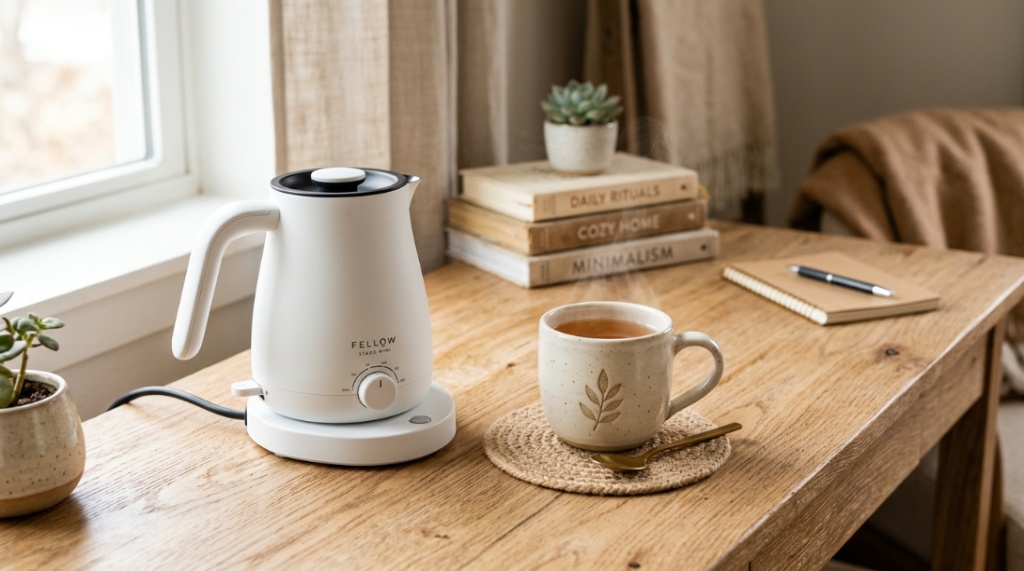
Yes, variable temperature kettles can save 15–25 percent energy compared to standard kettles when you use them correctly. The savings come from not boiling water to 100°C when you only need a lower temperature.
Different beverages require different temperatures:
- White tea: 70°C
- Green tea: 80°C
- Oolong tea: 90°C
- Black tea or coffee: 100°C
- Cooking or instant meals: 100°C
Boiling water to 100°C and then letting it cool to 80°C wastes the energy used to heat that final 20 degrees. It takes roughly 20 percent more energy to raise water from 80°C to 100°C than from room temperature to 80°C. A variable temperature kettle stops exactly at your target, capturing that savings every time.
Some premium models also include a hold function that maintains temperature for up to 30 minutes. This is energy efficient if you drink tea throughout the morning, because reheating from 80°C uses less power than a full boil. However, if you only make one cup and walk away, the hold function wastes energy. Use it strategically.
How to Test If Your Current Kettle Is Wasting Energy
You can perform a simple home test to gauge your kettle efficiency. Fill your kettle to its maximum line, boil it, and time how long it takes. Then pour that boiling water into a measuring cup to see exactly how much you boiled. If you regularly boil 1.7 liters but only use 500ml, you are wasting roughly 70 percent of the energy each time.
Another test: after the kettle clicks off, touch the outer body. If it feels hot to the touch, you are losing heat through the walls. A well-insulated kettle should feel warm but not hot on the outside. Plastic and single-wall stainless steel kettles fail this test badly.
Look for signs of scale buildup inside. Limescale acts as an insulator, forcing the heating element to work harder and longer to heat the same water. If you see white deposits, descale your kettle with vinegar or citric acid. A descaled kettle can boil up to 30 percent faster, directly translating to energy savings.
If your kettle fails any of these tests, it is likely costing you more in electricity than a new, efficient model would. The payback period for upgrading is often less than six months for regular users.
Can a Gooseneck Kettle Be Energy Efficient?
Gooseneck kettles can be energy efficient, but only if you match them to your usage pattern. The narrow spout design requires slower pouring, which some users enjoy for precise coffee preparation. However, the specialized shape often means less insulation and smaller capacities.
Most gooseneck kettles range from 0.6 to 1.0 liters, which is ideal for single or double cup brewing. Because you rarely boil excess water in a small kettle, gooseneck models can actually be more efficient than larger traditional kettles for coffee enthusiasts who only brew one pour-over at a time.
The downside is that many gooseneck kettles lack double-wall insulation. Look for stainless steel gooseneck models with temperature control features. The best ones include a keep-warm function that holds your precise brewing temperature without constant reheating. If you brew multiple cups throughout the morning, this can save substantial energy compared to boiling fresh water each time.
For pour-over coffee specifically, a gooseneck kettle with variable temperature is one of the most energy efficient choices available because it matches the water volume and temperature exactly to your needs.
When Should You Replace Your Old Kettle for Better Efficiency?
Replace your kettle immediately if you notice any of these warning signs: it takes longer to boil than when new, the exterior gets uncomfortably hot, the auto shutoff is inconsistent, or you see rust or corrosion inside. These issues all signal that the kettle is operating below peak efficiency.
For kettles that still function but are over five years old, consider upgrading if you boil water frequently. Older models typically lack double-wall insulation, temperature control, and modern concealed elements. The energy savings from a new energy efficient kettle can offset the purchase cost within one to two years of regular use.
Calculate your personal break-even point. If you boil your kettle three times daily and your current kettle uses 0.08 kWh per boil, that is 87.6 kWh per year. At the average US electricity rate of $0.14 per kWh, that is about $12.26 annually. A new efficient kettle using 0.06 kWh per boil would cost $9.19 annually, saving $3.07 per year. If the new kettle costs $40, it pays for itself in 13 years from energy savings alone, not counting the added convenience of faster boils and better temperature control.
For heavy users (six boils daily), the payback drops to under seven years. And if you combine savings with the elimination of wasted water and the convenience of faster service, the upgrade becomes worthwhile much sooner.
Is a Smart Kettle Worth the Energy Investment?
Smart kettles with app connectivity and scheduling features can save energy if you use them strategically, but they typically cost more upfront and consume standby power. The standby power draw is usually minimal, around 1–2 watts, which adds less than $2 per year to your electricity bill.
The real energy benefit of smart kettles comes from scheduling. If you can program your kettle to boil water exactly when you wake up, you avoid the waste of boiling water and then letting it sit and cool while you get ready. Some models even track your water usage and suggest efficiency improvements.
However, most smart kettle features are convenience-driven rather than efficiency-driven. The variable temperature, keep-warm, and precise fill features are what actually save energy, regardless of whether the kettle connects to Wi-Fi. A well-designed non-smart kettle with these features will be just as efficient as a smart model, and often cheaper.
Only choose a smart kettle if you will actually use the scheduling features. Otherwise, the extra cost pays for electronics you do not need.
How to Use Your Kettle for Maximum Energy Savings Every Day
These practical habits will double the efficiency of any kettle you own, regardless of its design:
- Boil only what you need. Use the water level markings. For one cup, fill to the minimum line, not the maximum.
- Descale monthly. Limescale buildup is the number one cause of energy waste. White vinegar descaling restores original efficiency.
- Cover the spout. If your kettle lacks a lid flap, cover the spout with a small towel while water heats. This prevents steam heat loss.
- Keep water hot. If you drink multiple cups, use the keep-warm function rather than reboiling. Reheating hot water uses 30–50 percent less energy than boiling cold water.
- Match temperature to beverage. Do not boil to 100°C for green tea. Use lower temperature settings whenever possible.
- Clean the base. Dust and debris on the power base can reduce electrical contact efficiency. Wipe it clean weekly.
- Use a thermos. If you boil water for later use, pour it into a preheated thermos rather than leaving it in the kettle where it cools faster.
These habits are free, take seconds to implement, and can reduce your kettle energy consumption by up to 40 percent over the course of a year.
Which Energy Efficient Features Actually Matter for Your Kitchen?
Not all efficiency features are equally valuable. Here is what to prioritize based on your real needs:
Must-have for everyone: Concealed stainless steel heating element, clear water level markings, and reliable auto shutoff. These features are present on most modern kettles and form the baseline for efficiency.
Highly recommended for daily users: Double-wall insulation and variable temperature control. These two features alone can reduce energy waste by 20–30 percent. They pay for themselves within months for three-times-daily users.
Nice to have for enthusiasts: Keep-warm function, gooseneck spout, and smart scheduling. These features are valuable only for specific usage patterns. Do not overpay for them if you just make morning tea.
Skip entirely: Colored LED lights, unnecessary digital displays that stay on constantly, and ultra-wide bases that take up counter space. These add cost and standby power without improving efficiency.
Focus your budget on double-wall stainless steel construction and temperature control. Those are the features that will save you real money every month.
Finding the right size is just as important as checking the wattage. If you only need to boil water for one or two cups at a time, a standard 1.7-liter model might waste residual heat. Opting for a smaller, compact model ensures you only heat exactly what you need. You can find similar space-saving, power-conscious tools in our curated guide to Affordable Mini Kitchen Appliances.
Frequently Asked Questions
How much electricity does an electric kettle use per month?
A typical household kettle used three times daily consumes approximately 7–10 kWh per month, costing between $1 and $1.40 at average US electricity rates. An energy efficient model can reduce this to 5–7 kWh monthly.
Does boiling less water save energy?
Yes. Boiling only the water you need saves 20–40 percent energy per use. Most households waste energy by overfilling. Simply matching water volume to your actual need is the single most effective efficiency strategy.
Is a plastic or stainless steel kettle more efficient?
Stainless steel kettles are significantly more efficient because they retain heat better. Plastic kettles cool quickly, losing heat through the walls. Double-wall stainless steel models are the most efficient option available for standard home use.
Can I use a kettle to save energy compared to a stovetop?
Yes. Electric kettles are 80–85 percent efficient at converting electricity to heat, while stovetop kettles on an electric burner are only 30–40 percent efficient. Using an electric kettle instead of a stovetop can cut energy use for boiling water by more than half.
How often should I descale my kettle for best efficiency?
Descaling every four to six weeks is recommended for homes with hard water. Monthly descaling if you notice visible scale. A descaled kettle boils faster and uses less energy because the heating element transfers heat directly to water instead of through an insulating layer of scale.
Does a rapid boil feature use more energy?
Rapid boil features simply use higher wattage to heat faster. While they draw more power momentarily, the shorter runtime often results in similar or slightly lower total energy consumption per boil compared to slower models. The difference is minimal in practice.
Are cordless kettles less efficient than corded models?
No. Cordless kettles (those that sit on a powered base) are equally efficient as corded models. The base connection introduces negligible resistance, and the convenience of lifting the kettle without unplugging makes them the standard recommendation.
Conclusion
Choosing an energy efficient kettle comes down to three things: material, size, and features. Double-wall stainless steel construction keeps heat where it belongs. The right size prevents wasted energy on excess water. Variable temperature control eliminates unnecessary full boils. These three choices together can cut your kettle energy use by 30 to 50 percent without changing your daily routine. Start by evaluating your current habits, then match a kettle to your real needs. The small upfront investment pays back every single time you flick that switch. Make your next cup of tea the most efficient one yet.
About Author
