A cycling buddy of mine switched from a trainer stand to rollers last November, convinced they’d improve his pedaling technique. Two weeks later, he crashed into his TV stand during a sprint interval — bike, rollers, and a 55-inch screen all hitting the floor simultaneously. The bike trainer stand vs bike rollers debate isn’t just about preference; it’s about matching equipment to your specific goals, skill level, and living situation. Choose wrong, and you’re either bored on a trainer or bleeding on your living room floor.
A bike trainer stand clamps your rear wheel (or replaces it) to hold your bike stationary while providing resistance. Rollers are three cylindrical drums that your bike balances on freely — requiring constant rider input to stay upright. Both enable indoor cycling, but they develop different skills and suit different training objectives.
What’s the Fundamental Difference Between a Trainer Stand and Rollers?
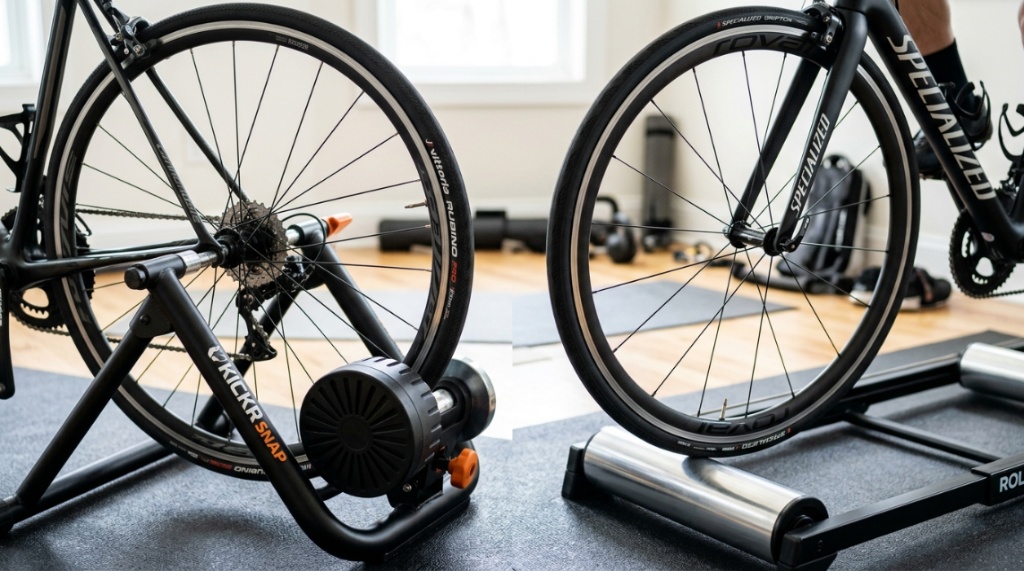
A trainer stand locks your bike in place for zero-balance, resistance-focused training. Rollers let your bike move freely, demanding constant balance and rewarding smooth pedaling technique — but offering less structured resistance control.
| Feature | Bike Trainer Stand | Bike Rollers |
|---|---|---|
| Bike stability | Completely fixed | Free-floating, requires balance |
| Learning curve | Immediate — mount and ride | 1–2 weeks to ride confidently |
| Resistance control | Adjustable (manual or electronic) | Limited (speed-dependent only) |
| Pedaling technique | No feedback on smoothness | Immediate feedback — wobble = poor technique |
| Sprint safety | Safe — bike can’t move | Dangerous — bike can roll off drums |
| Hands-free riding | Easy — grab water, towel anytime | Risky — requires skill and confidence |
| Tire wear | High (wheel-on) / None (direct-drive) | Moderate — both tires contact drums |
| Noise level | Low–Medium (type dependent) | Medium–High (drum vibration) |
| Price range | $50–$1,400 | $100–$500 |
| Smart connectivity | Common (mid-range and up) | Rare (few smart roller options) |
Who Should Choose a Bike Trainer Stand Over Rollers?
Choose a bike trainer stand if you prioritize structured interval training, need smart app connectivity, live in an apartment, or want zero learning curve to start riding immediately.
Trainer stands are the better choice when:
- You follow structured training plans: ERG mode and precise power targets require a trainer stand’s controlled resistance
- You use virtual platforms: Zwift, TrainerRoad, and Rouvy work best with smart trainer stands that auto-adjust resistance
- You do high-intensity intervals: Sprints and VO2max efforts are unsafe on rollers without guards
- You live in an apartment: Trainer stands (especially direct-drive) are quieter and transmit less vibration
- You’re new to indoor cycling: Zero balance requirement means you ride productively from day one
- You need hands-free moments: Drinking, adjusting fans, or checking your phone is safe on a fixed bike
- You want accurate power data: Smart trainer stands measure power within ±1-2% accuracy
Who Should Choose Rollers Over a Trainer Stand?
Choose rollers if your primary goal is improving pedaling smoothness, developing bike handling skills, warming up before races, or you find trainer stands unbearably boring and need the engagement of active balance.
Rollers excel for:
- Technique development: The instant feedback loop (wobble = poor form) trains smooth, circular pedaling faster than any drill on a trainer
- Race warmups: Compact, portable, and quick to set up at race venues
- Core engagement: Maintaining balance activates stabilizer muscles that trainer stands don’t challenge
- Mental engagement: You can’t zone out on rollers — the balance requirement keeps you present
- Natural road feel: The bike moves laterally like it does outdoors, maintaining neuromuscular patterns
- Experienced cyclists: Riders with strong bike handling skills adapt quickly and benefit most from technique refinement
How Does Training Effectiveness Compare Between the Two?
For pure fitness development (FTP, VO2max, endurance), trainer stands are more effective because they allow precise intensity control. For pedaling efficiency and bike handling, rollers provide superior skill development that indirectly improves outdoor performance.
Training effectiveness breakdown:
Trainer stand advantages for fitness:
- ERG mode holds exact wattage targets during intervals — no guessing, no drifting
- Progressive resistance allows overload training (increasing watts week over week)
- Power measurement enables Training Stress Score (TSS) tracking for periodization
- Safe for all-out efforts — sprint intervals, standing climbs, maximum power tests
Roller advantages for skill:
- Pedaling smoothness improves measurably within 2–4 weeks of regular roller use
- Core stability transfers directly to outdoor cornering and group riding confidence
- Single-leg drills on rollers provide immediate balance feedback impossible on trainers
- Cadence control improves — high cadence on rollers requires genuine smoothness
Research from cycling performance labs suggests that pedaling efficiency improvements from roller training can translate to 2–5% power savings at equivalent speeds — meaningful for competitive cyclists.
Which Option Is Safer for Home Use?
Trainer stands are significantly safer — your bike cannot fall, roll, or move unexpectedly. Rollers carry real crash risk, especially during high-intensity efforts, fatigue, or momentary distraction.
Safety comparison:
- Trainer stand crash risk: Essentially zero. The bike is mechanically locked in place. The worst case is a clamp failure, which is extremely rare with proper installation.
- Roller crash risk: Moderate for beginners, low for experienced users. Common scenarios: looking away from the front wheel, sprint efforts that shift weight, fatigue-induced loss of concentration, and reaching for water bottles.
Roller safety measures if you choose them:
- Position in a doorway or hallway where walls prevent sideways falls
- Use rollers with front fork guards (bumpers that prevent the front wheel from rolling off)
- Start near a wall or countertop you can grab
- Never attempt standing sprints until you have 50+ hours of roller experience
- Keep intensity moderate — save all-out efforts for the trainer stand
How Do Noise Levels Compare for Apartment Dwellers?
Trainer stands (especially fluid and direct-drive) are quieter than rollers. Rollers produce 65–80 dB due to both tires contacting drums simultaneously, plus the drums themselves vibrate against the floor.
Noise breakdown:
- Direct-drive trainer: 55–65 dB (quietest option available)
- Fluid wheel-on trainer: 60–68 dB
- Standard rollers: 70–80 dB (both tires + drum vibration)
- Premium rollers with dampening: 65–72 dB
Rollers create a unique noise challenge: the drums themselves resonate against the floor surface, creating a low-frequency hum that travels through building structures. Even with a mat underneath, rollers typically transmit more vibration than a well-isolated trainer stand. For apartment living, trainer stands win the noise comparison decisively.
Can You Use Both a Trainer Stand and Rollers?
Yes — many serious cyclists own both and use them for different purposes. Trainer stand for structured intervals and hard efforts; rollers for warmups, recovery rides, and technique sessions.
A dual-equipment approach works well:
- Monday (recovery): 30 minutes easy spinning on rollers — technique focus, low intensity
- Tuesday (intervals): 60 minutes on trainer stand — VO2max repeats with ERG mode
- Wednesday (endurance): 75 minutes on rollers — steady pace, pedaling drills
- Thursday (threshold): 60 minutes on trainer stand — 2×20 FTP intervals
- Saturday (long ride): 90+ minutes on trainer stand — virtual group ride on Zwift
This combination develops both fitness (trainer stand) and technique (rollers) simultaneously. The variety also combats indoor training boredom — switching between two different riding experiences keeps sessions fresh.
What About Smart Rollers — Do They Close the Gap?
Smart rollers with electronic resistance and app connectivity close much of the gap, offering structured training capability while maintaining the balance and technique benefits — but they cost $500–$1,000 and remain noisier than equivalent smart trainer stands.
Smart roller features now available:
- Bluetooth/ANT+ connectivity for Zwift and TrainerRoad
- Electronic resistance control (ERG mode on some models)
- Power measurement within ±3-5% accuracy
- Progressive resistance that simulates gradients
- Front fork guards for improved safety during hard efforts
The trade-off: smart rollers cost as much as mid-range direct-drive trainers while being louder, less accurate on power, and still carrying balance risk. They make sense for cyclists who specifically value the technique benefits of rollers but want structured training capability — a niche audience.
Which Is More Portable for Travel or Race Warmups?
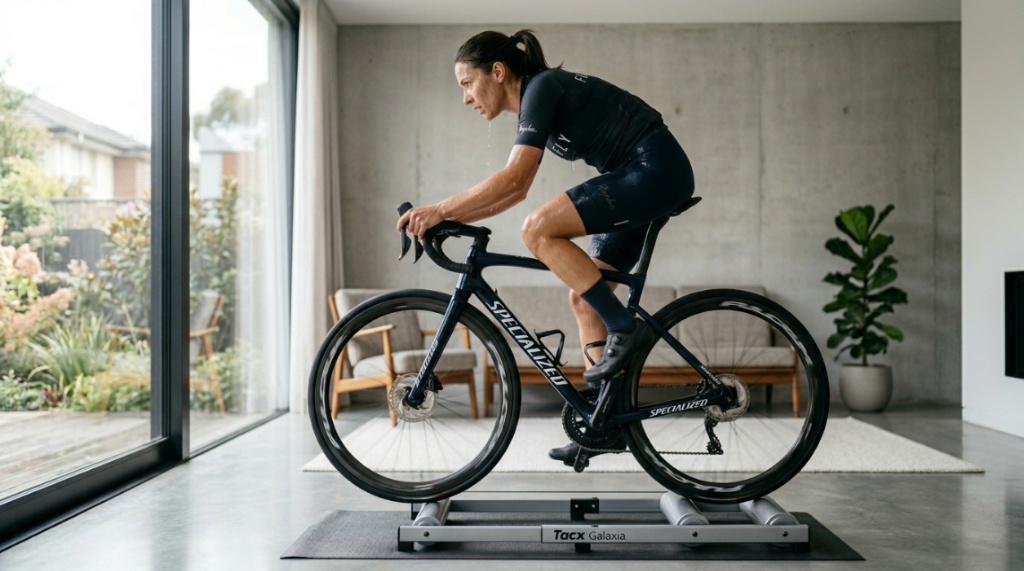
Rollers are more portable — they fold flat, weigh 15–22 pounds, and require no attachment to your bike. Trainer stands (especially direct-drive) are heavier and bulkier, making rollers the clear choice for race-day warmups.
Portability comparison:
- Rollers: Fold to approximately 4 feet × 6 inches × 6 inches. Fit in a car trunk alongside a bike. Setup time: 30 seconds (unfold and ride).
- Wheel-on trainer: Fold to approximately 2 feet × 1.5 feet × 6 inches. Heavier but more compact. Setup time: 3–5 minutes (mount bike, adjust roller).
- Direct-drive trainer: Don’t fold. Weigh 35–50 lbs. Require a cassette and rear wheel removal. Not practical for travel.
For race warmups specifically, rollers dominate. Professional cycling teams universally use rollers at race venues — they’re fast to deploy, require no bike modification, and the balance engagement activates neuromuscular pathways that prepare riders for the dynamic demands of racing. If stability and ease of use are your top priorities, a stationary stand is usually the safest bet. It locks your rear axle in place, allowing you to zone out or watch a screen without losing your balance. However, to get the most out of this stationary setup, you need to ensure your geometry and environment are dialed in correctly. Take the time to set up an indoor bike trainer for maximum comfort to prevent knee strain and saddle sores during long, static winter sessions.
Conclusion
The trainer stand vs rollers decision comes down to your primary training goal. If structured fitness development, smart app integration, and apartment-friendly noise levels matter most — get a trainer stand. If pedaling technique, mental engagement, and race-day portability are priorities — rollers serve you better. Many cyclists eventually own both, using each for its strengths.
For most indoor cyclists — especially those training with power targets, using virtual platforms, or living in apartments — a quality trainer stand delivers more value. Rollers are a specialized tool that rewards experienced cyclists willing to invest time in the learning curve. Neither is universally “better”; they solve different problems.
Which setup are you leaning toward? Drop your training goals in the comments and I’ll recommend the specific type that matches your situation.
Frequently Asked Questions
Can beginners use bike rollers safely?
Yes, with precautions. Position rollers in a doorway or next to a wall for support. Start with low gear and slow speed. Most beginners ride confidently within 5–10 sessions. However, expect wobbling and potential dismounts during the first few attempts — clear the surrounding area of fragile items.
Do rollers damage bike tires faster than trainer stands?
Rollers cause moderate wear on both front and rear tires simultaneously, while wheel-on trainer stands wear only the rear tire but more aggressively due to higher contact pressure. Overall tire cost is similar — approximately $30–$50 every 3–6 months of regular use for either option.
Can you do Zwift on bike rollers?
Yes, if you have smart rollers with Bluetooth/ANT+ connectivity, or if you add a separate speed/power sensor. However, the experience is limited — most rollers don’t support automatic resistance changes, so virtual hills won’t feel different. Smart rollers ($500+) offer full Zwift integration including ERG mode.
Are rollers better for warming up before a race?
Yes. Rollers are the standard warmup tool for competitive cyclists because they’re portable, require no bike modification, set up in 30 seconds, and the balance engagement activates stabilizer muscles and neuromuscular pathways that prepare you for dynamic racing conditions.
Which burns more calories — trainer stand or rollers?
At equivalent power output, calorie burn is identical regardless of equipment. However, rollers engage more core and stabilizer muscles for balance, adding a small additional caloric cost (estimated 3–5% more). The practical difference is negligible — workout intensity and duration determine calorie burn far more than equipment choice.
Can you stand up and sprint on rollers?
Experienced roller riders can stand and sprint, but it requires significant skill and carries crash risk. The bike moves laterally during standing efforts, and any imbalance can send you off the drums. Most coaches recommend keeping sprints and standing efforts on trainer stands and using rollers for seated technique work only.
About Author
