Dinner time is chaos. You’re juggling school runs, activities, homework, and work, and the last thing you need is a complicated meal plan that requires an hour of hands-on cooking. A pressure cooker can genuinely change that daily grind, turning cheap cuts of meat into tender, flavorful meals in a fraction of the time. But with so many models on the market, choosing the right one can feel like another chore on the list. This guide breaks down exactly what makes a pressure cooker ideal for a busy household and helps you pick the model that fits your actual routine—not just a gimmicky feature list.
We’ll cover sizing, ease of cleaning, safety, and the specific functions that genuinely save time, plus whether a multi-cooker or a traditional stovetop model makes more sense for your family. By the end, you’ll have a clear, practical checklist to confidently choose a pressure cooker for busy families that you’ll actually use every week.
Key Takeaways
- For most busy families, a 6-quart electric pressure cooker offers the best balance of capacity, countertop convenience, and set-it-and-forget-it safety.
- True time savings come from the “keep warm” function and delay start, which let you cook ahead of schedule without hovering over the appliance.
- Dishwasher-safe parts (inner pot and lid) matter more than extra cooking modes when you’re short on time and energy.
- Stovetop models cook faster and brown better but require attention; electric models are safer for novice cooks and older kids helping in the kitchen.
How to Choose the Right Size for a Household
The most common mistake families make is buying a cooker that is too small, which forces them to cook in batches and defeats the entire purpose of time savings. While a 3-quart seems like a good idea for counter space, it realistically only feeds two adults with zero leftovers. For a family of four or more, a 6-quart model is the industry standard because it holds a whole chicken, a large pot roast, or enough chili to feed the family plus save a lunch for the next day.
If you consistently cook for five or more people and rely on leftovers for weekday brown-bag lunches, a compact 8-quart electric unit is worth the extra counter space. Larger pots also handle bulk cooking like bone broth or batch-cooking dry beans, which many family cooks find is the real money-saver on their grocery bill. Remember that you cannot fill a pressure cooker more than two-thirds full for most foods, so the usable capacity is less than the total volume.
Why Capacity Impacts Cooking Time
Filling a 6-quart pot halfway for a 3-quart meal works well, but filling it to the max with a large roast and vegetables increases the time it takes to come up to pressure and release pressure. That does not mean it is inefficient; it simply means you need to be realistic about how long “get home, cook fast” actually takes when the pot is packed full.
Electric models typically take 10–15 minutes to preheat and build pressure, and natural pressure release (letting the steam dissipate on its own) can take another 10–20 minutes. That passive cooking time is what makes a pressure cooker excellent for busy families—you can walk away and handle the bedtime routine while it naturally releases.
Electric vs. Stovetop: Which Fits a Busy Schedule?
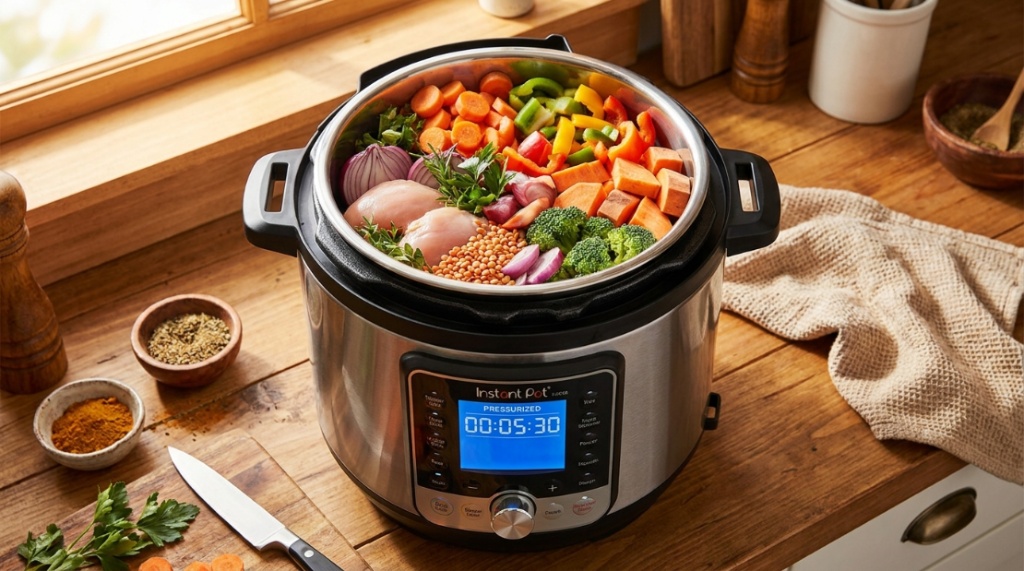
If you are deciding between a stovetop pressure cooker and a plug-in electric multi-cooker, your tolerance for monitoring is the deciding factor. Stovetop models get hotter, braise meats more deeply, and cook faster, but they require a good amount of attention to maintain the correct pressure level. You can’t easily leave a stove-top cooker unattended, especially if you have a responsive gas flame or an electric coil that cycles.
For most working parents, an electric pressure cooker (like an Instant Pot or similar multi-cooker) wins because the machine regulates the temperature automatically. No tuning the burner lower. No frantic guessing about whether you’ve reached the right pressure. Set it, let it come to pressure, and get on with helping with homework or unloading the dishwasher.
Additionally, electric versions have a delay-start timer and a durable keep-warm cycle. If you come home from work at 5:30 PM but want dinner at 6:30 PM, you can prep the ingredients in the morning, set the timer, and come home to a fully cooked meal. That is a scheduling game-changer that no stovetop model offers.
What Safety Features Matter Most
Safety is naturally a top concern, especially if older kids are involved in meal prep. The best pressure cookers for beginners and novice family cooks have multiple redundant safety mechanisms. First, look for a lid that locks securely when pressure is present, so you cannot open the pot while it is cooking. Second, seek a model with a float valve or indicator pin that visibly drops when the pressure has fully released.
Third, choose a model with an automatic pressure-release valve that you can trigger remotely—many electric cookers let you press a button to vent steam rather than using a manual handle. That is extremely important when you have curious toddlers underfoot, as it prevents a dangerous burst of hot steam near face level. Stovetop models lack this automation and require more caution and adult supervision.
Which Cooking Modes Actually Add Value
Multi-cookers often sell based on having a dozen preset buttons: soup, porridge, rice, meat, and even slow cook and yogurt. But the reality is that for most weeknight dinners, you will primarily use two modes: high pressure and sauté/browning. The sauté function is vital because it lets you brown ground beef or caramelize onions before pressurizing, which adds serious depth of flavor without pulling out a separate skillet.
Do not let a long list of preset modes dictate your purchase. Many “smart” settings are simply a fixed time and temperature preset that you can manually adjust anyway. A better strategy is to buy a model with minimal buttons but a high degree of adjustability, or one that saves your custom times for repeated meals like “steel-cut oats” or “15-minute mac and cheese.”
Keep Warm and Delay Start Are the Two Features That Matter
Busy families need food ready when they are ready, not when a fixed timer says it is done. The keep warm feature is non-negotiable because if you are stuck in traffic or dealing with a toddler meltdown, you do not want dinner to get cold. The best electric cookers hold food at a safe temperature above 140°F for hours, meaning you can cook a pork shoulder at noon and serve it at 7:30 PM if needed.
Delay start is also helpful but has caveats. Avoid using a long delay start with fresh meat or dairy that sits at room temperature or lukewarm within the pot before cooking, which risks bacterial growth. Use delay start for steel-cut oats, regular dried beans, or any recipe with mostly shelf-stable ingredients, then cook your protein fresh when you get home.
Ease of Cleaning: A Deciding Factor for Long-Term Usage
A pressure cooker that is difficult to clean will quickly get banished to the back of a cabinet. The key consideration here is which parts are dishwasher-safe. The best models have a removable stainless steel inner pot that can go straight into the dishwasher, along with the sealing ring and the lid. Silicone sealing rings absorb odors—that is expected—but they should be easy to pop out and clean separately.
Be wary of painted or non-stick interior coatings. While they are lighter and easier to wipe out, they can chip over time, especially with a metal spoon or frequent dishwasher cycles. Stainless steel is more forgiving and does not degrade under high-heat pressure.
- Stainless steel inner pot: Durable, dishwasher-safe, no chipping, and safe for high-heat searing.
- Non-stick inner pot: Easier to clean by hand but sensitive to scratching and not always dishwasher-safe.
- Sealing ring design: Should easily pop out for cleaning and replacement—expect to buy new rings every 12–18 months.
The “Pot-in-Pot” Method and Meal Prepping with Pressure Cookers
Once you own a cooker, the real time-saving trick for busy families is learning to cook multiple components at once. The “pot-in-pot” method involves placing a trivet at the bottom of the main pot and placing a separate oven-safe bowl on top. This allows you to cook brown rice or quinoa in the bowl while the main pot contains your chili, curry, or shredded chicken. Both cook simultaneously under pressure.
This saves 30 minutes of additional cooking time on busy nights. Many experienced users recommend buying a simple steamer basket and a set of stackable pans—these are much cheaper than buying a second cooker. You can also prepare three meals at once: hard-boiled eggs for the kids’ snacks, potatoes for one dinner, and boneless chicken breasts for tomorrow’s casserole.
This practical approach does require a pressure cooker with a large capacity. A 6-quart pot handles the standard trivet plus one bowl; an 8-quart pot handles stacked levels with two bowls.
Common Mistakes to Avoid When Buying a Pressure Cooker
Several repeated errors keep families from enjoying their pressure cookers. Understanding how to avoid these will save you money and frustration. First, avoid models with plastic or secondary lids that are not dishwasher safe; you end up hand-washing them to prevent warping, which adds daily steps. Second, avoid buying a unit that lacks a visible and accessible steam release handle if you hate waiting on natural release for recipes requiring quick release like green beans or seafood.
Third, do not underestimate the weight of the unit. An electric pressure cooker with a ceramic or metal outer body can weigh over 15 pounds. If you plan to store it in a cabinet, you will stop using it quickly because it is a hassle to haul out. Countertop model designs require you to leave them plugged in and accessible,upgrade your culinary setup with more smart gear by exploring our guide on top affordable mini kitchen appliances.
Why BTU and Wattage Matter Less Than You Think
Marketing hype often focuses on wattage (800 vs. 1000 watts). While higher wattage means slightly faster heating, the difference between 1000 and 1200 watts in an electric cooker is only a few minutes of preheat time. The cooking time under pressure is identical because pressure cooking is dictated by the boiling point of water at a fixed pressure—that is what makes a pressure cooker fast.
Focus instead on the seal. A robust silicone gasket and a strong, simple lid-locking mechanism will determine your long-term satisfaction. A good seal means you do not lose steam and therefore do not lose moisture or heat, which prevents those frustrating “burn” errors and undercooked meat incidents.
Budget and Warranty Considerations
Price ranges for electric pressure cookers are wide, starting under $60 for very basic models up to $200+ for professional-grade smart cookers. When choosing a pressure cooker, however, a higher price does not guarantee better meals. Expensive smart features like Wi-Fi and app connectivity are rarely necessary for busy weeknight cooking—you only need these if you love cooking sous-vide-style dishes or want to start a meal from the couch.
Make sure the unit has at least a one-year warranty from the manufacturer. Three-year warranties are better. Replacement parts should be available—especially the sealing ring, the condensation collector, and the inner pot. If you cannot buy a replacement inner pot for a model, skip that one because scratched inner pots often cause burnt-food errors down the line.
Frequently Asked Questions
Can a pressure cooker replace a slow cooker for family meals?
Yes, most electric pressure cookers have a slow-cook setting. However, they do not heat as gently as a dedicated slow cooker on “low,” so the results differ. For shredding chicken and cooking tougher cuts fast, pressure is better. If you need to cook overnight for 8 hours, a dedicated crockpot is still a safer choice than a pressure cooker, which should not be left running overnight long-term.
Is a 6-quart or 8-quart pressure cooker better for a family of five?
A 6-quart can handle a 4-lb roast and vegetables, which often feeds five, but it fills to the top. An 8-quart offers more headspace for soup and lets you use the pot-in-pot method for making rice or a side dish simultaneously. If you enjoy leftovers or meal prepping, the 8-quart is worth the extra cost and kitchen space.
Should I buy an air fryer or a pressure cooker?
These are not interchangeable. A pressure cooker excels at moist heat cooking—braising, steaming, and beans—producing shredded meat and grains faster. An air fryer uses dry hot air for crispness, ideal for reheating leftovers and making fries. Many families benefit from buying an affordable pressure cooker first, then adding a small air fryer if their family misses crispy textures.
How do I stop food from burning on the bottom of the pressure cooker?
Most “burn” warnings happen when food high in sugar or starch sticks to the bottom. Always deglaze the pan when cooking with tomato paste or sugar-based sauces, add a little liquid (broth, tomato juice, water) and stir thoroughly before locking the lid. Using a quick-release method instead of a natural release also prevents the bottom from scorching after the program finishes.
Are electric pressure cookers safe to use with kids around?
Yes, when used properly, electric pressure cookers have secure lock mechanisms, and the steam release is restricted. However, always place the vent away from high-traffic areas and never allow a child to press the steam release button. Like any appliance, users should read the safety instructions and use the “keep warm” setting to buffer against accidents.
Conclusion
Choosing the perfect pressure cooker for a busy family does not need to be stressful, but it does require paying attention to practical details rather than flashy marketing. The best choice is an electric multi-cooker with at least a 6-quart capacity, dishwasher-safe parts, and reliable keep-warm functionality. It must be heavy enough to be stable but light enough to handle, and always from a brand that offers cheap replacement parts.
Take your current week’s menu into consideration—if you eat a lot of chili, soup, or shredded chicken, you will get enormous value from an electric cooker. While stovetop models are loved by purists, the set-and-forget smart features of an electric unit are what consistently save time for a frazzled parent. Pick one that lets you cook once and eat twice, and you will wonder how you ever managed weeknight dinners without it..
About Author
