Hotel fire risk assessment is not the same as office or shop fire risk assessment. Guests are on site overnight, do not know the internal layout and will not wake up quickly enough in the event of an emergency. Therefore assessment of sleeping risk needs to be taken into account when completing a fire risk assessment for hotels.
Sleeping Risk Changes The Rules
A hotel is a higher risk premises than a normal workplace as people sleep at night and there is no guarantee that guests will remember the emergency procedures that have been explained to them during the day. The Fire Risk Assessment for a hotel therefore needs to take account of the need for adequate detection, means of escape and action to be taken by staff in the event of an emergency at night when the hotel is closed and the staff on duty are trying to deal with a fire incident whilst guests are asleep and may be affected by alcohol.
Clear Evacuation Notices In Every Room
Every bedroom door should have visible evacuation information (including nearest exit, assembly point and what to do if the corridor is smoking) that can’t be knocked, covered up or lost after a refurbishment. Try to check these on an ongoing basis as they often get forgotten about.
Corridor Fire Doors Must Self-Close Properly
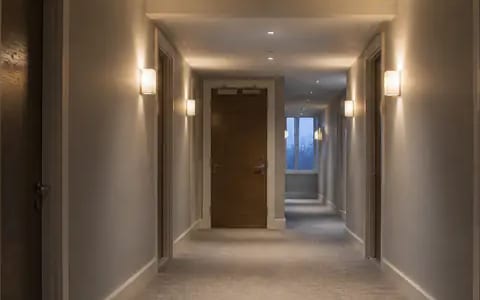
Fire doors within the bedroom corridors must be able to shut fully and latch, and make sure that all the self-closers are in good working order. This is a particular problem where housekeeping trolleys and linen carts are left blocking the doors, often for hours at a time. It should be made a standing instruction that no fire door is ever to be propped open, even for a short time.
Night Cover Needs A Trained Fire Marshal
While the number of guests may have decreased over the quiet midweek nights, the risk remains. A person needs to be on duty to deal with any incidents that may occur. Although the reception may be closed, a trained Fire Marshal should be on duty 24/7. The Fire Marshal should be able to raise an alarm and know where the assembly point is for all guests. The Fire Marshal should also be able to assist guests with disabilities to exit the premises if required.
Fire Risk Assessment Northamptonshire is covered in more detail at ISE Fire Products.
Kitchens, Laundries And Linen Stores Count Too
Areas that are designated for behind the front desk functions are often not given the same amount of consideration as the areas that guests frequent. However, the areas that support the hotel such as kitchens, laundry rooms and linen stores can pose a large fire risk. Extraction systems in kitchens need to be regularly cleaned to prevent grease buildup in ductwork. Laundries are often left unattended for long periods of time and can produce a lot of heat. Combustible materials are stored in very compact spaces in linen stores.
Personal Evacuation Plans For Guests Who Need Them
Where a guest with a mobility, hearing or sight impairment has informed a hotel of their disability, this needs to be translated into a Personal Evacuation Plan or “PEP” and noted in the Fire Risk Assessment Northamptonshire hotels arrange. Guidance on making reasonable adjustments for people with disabilities in hotels sets out what you must do to support guests with disabilities, and this needs to be worked into your Fire Risk Assessment in order to assist those guests in the event of an emergency and ensure that all guests can be evacuated safely in the event of a fire.
Function Rooms Change The Numbers
A hotel designed for 60 people can become a completely different beast when it hosts a wedding reception or business conference for 200 people or more for an evening. The assessment needs to take into account the length of time it may take for people to exit the premises, the number of unfamiliar people that the staff will have to evacuate and the possibility that exits could be blocked by extra furniture and staging put in place by the client. A fire risk assessment therefore needs to be revisited on nights when the hotel is hosting events and an assessment of the capacity of exits and the required staff to manage an evacuation completed.
An effective Fire Risk Assessment for a hotel will consider the premises at the quietest part of the day as well as at peak and will provide for all guests but particularly those with greatest need.
About Author
