Key Takeaways
- Define your family’s must-haves before you search any listings.
- Check school zones, because a lease does not guarantee a school seat.
- Verify safety with official crime data and visits at different hours.
- Test your real commute, and look up flood and storm risk.
- Meet neighbors and visit the area with your children.
Choosing where to rent is a big decision for any parent. The Southeast offers warm weather, lower costs, and many growing communities. However, quality varies from one neighborhood to the next. A great school zone may sit next to a busy highway. Therefore, you need a clear plan. This guide explains how to find family-friendly rental neighborhoods in the Southeast. It covers schools, safety, daily life, and regional risks. Follow these steps, and you can rent with confidence.
Start With Your Family’s Priorities
Every family needs something different. A family with toddlers may want parks and daycare nearby. However, a family with teenagers may care more about school programs and sports. Therefore, write down your priorities before you browse.
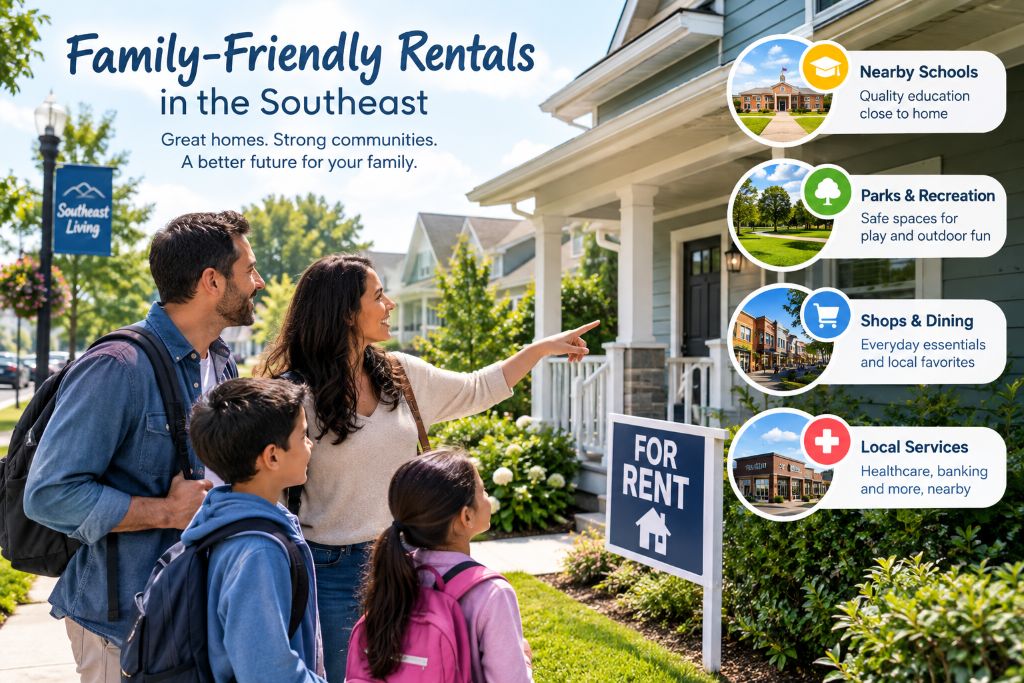
Most experts agree on a few core features. Property managers commonly list safety, good schools, and access to parks and playgrounds as the key traits of a family-friendly area. Walkable streets and nearby grocery stores also help. Additionally, easy access to healthcare matters when children get sick.
Next, set a firm budget. Rent should leave room for childcare, transport, and school costs. Many financial experts suggest keeping rent near 30 percent of income. If rent takes more, your family may feel stress in other areas.
Use this simple list to rank your needs:
- Must-haves: Examples include a safe street, a bedroom for each child, and a school within reach.
- Nice-to-haves: Examples include a pool, a fenced yard, or a playground on site.
- Deal-breakers: Examples include a long commute, no sidewalks, or high flood risk.
Then share the list with your partner. Agreeing early prevents arguments later. Finally, decide how far you can drive to work each day. A short list of clear rules helps you say no to poor options quickly. As a result, your search becomes faster and less tiring.
Research Schools and Safety Carefully
Schools and safety top most parents’ lists. Therefore, spend real time on both. Do not rely on a single website or a listing description.
Start with schools. Search for the public school zone tied to each address. Zones can change from one street to the next. Additionally, contact the school district office to confirm the zone. A rental agent may not know the latest boundaries.
Look beyond test scores. Check class sizes, after-school programs, and support for special needs. Similarly, ask about bus routes and start times. Many Southeast districts are growing fast, so some schools have long waitlists or crowded classrooms.
Now look at safety. Use official police crime maps for the city or county. Then compare several neighborhoods. Additionally, search the national sex offender registry for addresses near the property. Remember that crime can change block by block.
Visiting in person adds important detail. RentCafe advises touring several times at different hours and bringing your children along. It also suggests talking with current residents. Try these checks:
- Visit on a weekday morning and on a weekend night.
- Note street lighting, traffic speed, and sidewalk quality.
- Ask neighbors how safe the area feels.
- Check whether the building has secure entry and working locks.
- Look for signs of upkeep, such as trimmed lawns and clean shared spaces.
Finally, trust your instincts. If a place feels wrong, keep looking.
Compare Neighborhoods and Daily Life
Once you have a short list, compare how each area fits daily life. A good home should make routines easier, not harder.
Begin with parks and activities. Family-friendly communities usually offer playgrounds, trails, libraries, and sports leagues. For example, one guide notes that Cary, North Carolina, has more than 60 parks and greenways. Suburbs like this appeal to families who want outdoor space and community programs.
Next, consider cost. Rents differ widely across the region. Extra Space Storage’s city guide lists median monthly rent near $1,464 in Alpharetta, Georgia, and about $1,553 in Franklin, Tennessee. It shows a far lower figure of about $868 in Huntsville, Alabama. These numbers show how much location affects your budget. Always check current listings, because prices change quickly.
Commute time deserves special attention. Test your route at the actual time you would drive. A trip that takes 15 minutes at noon may take 40 minutes at rush hour. Additionally, count the drive to school and daycare. Long commutes reduce family time.
Consider these local factors as well:
- Heat and shade: Choose areas with trees and shaded playgrounds for summer months.
- Public transport: Many Southeast cities rely on cars, so plan for fuel and parking.
- Neighbors: Check for other families, community events, and active neighborhood groups.
- Nearby services: Look for pediatricians, urgent care, and grocery stores within a short drive.
Moreover, walk the neighborhood with your family. Notice whether children play outside and whether people greet each other. These small signs reveal a lot about community life.
Check Risks and Rental Terms Before You Sign
Even a lovely neighborhood can carry hidden risks. The Southeast faces hurricanes, heavy rain, and flooding. Therefore, research the property’s flood zone before you commit. The Federal Emergency Management Agency offers a free flood map tool online. Additionally, ask the landlord whether the unit has flooded before.
Renter’s insurance is also wise. It protects your belongings and covers temporary housing costs after a covered loss. Policies are often inexpensive, and many landlords require them. However, standard policies usually exclude flood damage, so ask about a separate flood policy.
Now review the lease with care. Families should look at these points:
- Lease length: A longer lease can protect you from sudden rent increases.
- Renewal terms: Ask how much rent may rise next year.
- Child safety: Check for window guards, working smoke alarms, and safe stairs.
- Pest and repair rules: Confirm who fixes problems and how fast.
- Deposit and fees: Know what you pay upfront and what you may get back.
Furthermore, ask about lead paint if the home was built before 1978. Federal law requires landlords to share known lead hazards. Take photos of the unit before you move in. These records protect your deposit later.
Finally, avoid scams. Never send money before you see the property and meet the owner or manager. Be careful with listings that seem too cheap.
Conclusion
Finding family-friendly rental neighborhoods takes research, but the effort pays off. Start with your family’s priorities and budget. Then check schools, safety, and commute times with real data and personal visits. You can also explore nearby attractions and outdoor activities, such as why scenic bicycle trails in Bronx, NY are becoming popular among tourists, to get a better sense of the area’s lifestyle. Additionally, look at flood risk and read the lease closely. When you combine these steps, you can choose a home where your children feel safe and happy.
Take action today. Write your top five priorities, and shortlist three neighborhoods. Then visit each one with your family at different times of day. Share your best tip in the comments, and subscribe to our newsletter for more practical housing advice.
Frequently Asked Questions
What makes a neighborhood family-friendly?
Safety, good schools, parks, and walkable streets matter most. Friendly neighbors and short commutes also help.
How can I check if a rental neighborhood is safe?
Use official police crime maps and the national sex offender registry. Then visit at different hours and talk to residents.
Does renting in a school zone guarantee my child a seat?
Not always. Districts set rules and capacity limits. Therefore, confirm with the school district before you sign a lease.
Should I worry about flooding when renting in the Southeast?
Yes. Check FEMA’s flood maps and ask the landlord about past damage. Also buy renter’s insurance and ask about flood coverage.
When is the best time to search for a family rental?
Late spring and summer are busy, since families move between school years. However, fall and winter often bring lower prices and more negotiation room.
About Author
